If you have embraced kettlebell training, you already know the unmatched power of the iron. Swings, presses, and goblet squats build a formidable shield of muscle, bone density, and core stability.
But if we are honest about heavy kettlebell training, it is a highly intense, linear, and gripping practice. It demands that you crush the handle with all your might, brace your core like a stone wall, and move primarily forward and back. Over time, this intense tension can leave your shoulders feeling tight, your forearms stiff, and your joints craving release.
Many seniors try to balance this out with trends like "ropeless battle ropes" to get extra cardio. But repeating aggressive, high-intensity slamming movements only adds more fatigue to an already hard-working nervous system, while placing abrupt, jarring deceleration stress on your elbows and wrists.
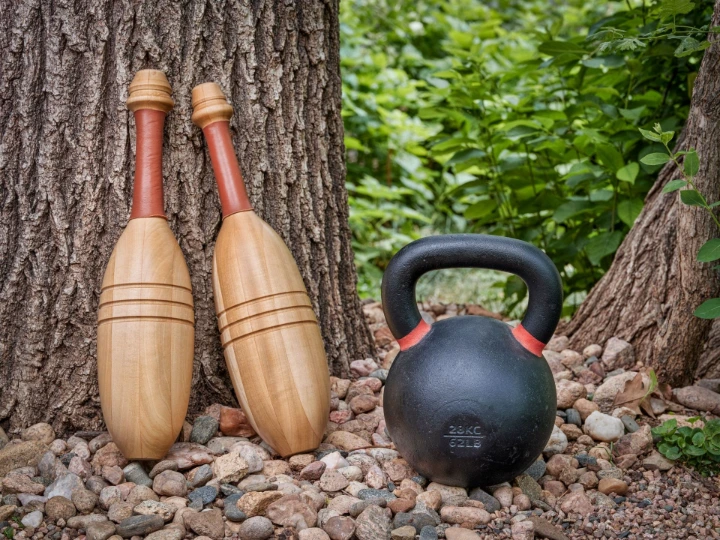
To balance the heavy load of the kettlebell, you don't need more aggressive tension. You need the ultimate joint-restoring partner: Indian Clubs.
Do You Know?
Dating back centuries as a foundational physical conditioning tool, Indian Clubs offer exactly what a heavy kettlebell practice leaves out: unloaded, multi-directional, joint-restorative movement.
While kettlebells build strength through tension, Indian clubs restore your body through circular momentum.
Why Indian Clubs are a Kettlebell Lifter's Secret Weapon
Restores and Protects the Rotator Cuff: Heavy overhead presses and kettlebell swings heavily recruit your large pushing and pulling muscles (like your lats and pecs). Indian clubs target the four smaller, stabilizer muscles of your rotator cuff, gently restoring healthy joint space and preventing the pinching or impingement that often occurs in aging shoulders.
Builds Rotational Coordination: Almost all standard kettlebell movements happen in the sagittal plane (moving straight forward and back) or the frontal plane (side to side). Indian clubs force your body into the transverse (rotational) plane. Swinging them teaches your hips, spine, and shoulders to coordinate rotational movement fluidly—the exact skill you need to reach comfortably behind you or recover from a twisting slip.
Decompresses the Joints: Unlike exercises that require tight, aggressive muscular contractions, swinging light Indian clubs utilizes traction and centrifugal force. The momentum of the club gently pulls the shoulder joint slightly open (decompression), which floods the joint with lubricating synovial fluid, soothing chronic tendonitis and stiffness.
Enhances Grip and Wrist Suppleness: Kettlebell training requires a tight, crushed grip to control the bell. Indian clubs teach grip transitioning—alternating between a secure, closed grip at the bottom of a swing and a relaxed, open-finger hold at the top. This dynamic transition keeps your wrist joints, fingers, and forearm tendons incredibly supple and pain-free.
What Can Be Done?
The beauty of incorporating Indian clubs into your routine is that they require almost zero recovery time. Because they are exceptionally light, they do not add to your systemic training fatigue. Instead, they act as active therapy.
For a senior kettlebell athlete, you do not need heavy clubs. A pair of 1-pound or 1.5-pound wooden or polyurethane clubs is more than enough to fully stimulate your nervous system and lubricate your joints.
Here is how you can seamlessly weave this elegant tool into your weekly schedule:
The Restorative Blueprint
1.The Dynamic Warm-Up:10 Minutes (Before Lifting).
Use your clubs before your main kettlebell sessions. Spending 5 to 10 minutes practicing outward and inward heart-shaped circles, wrist circles, and basic "mills" will wake up your nervous system, activate your shoulder stabilizers, and fully lubricate your joints before you pick up a heavy bell.
2.The Active Recovery Session:15 Minutes (On Rest Days).
On your non-training days (the crucial 48-to-72-hour recovery windows), spend 15 minutes swinging your clubs at a relaxed, rhythmic pace. This flushes oxygen-rich blood into tight upper-body tissues, reduces muscular soreness, and maintains your shoulder range of motion without triggering any central nervous system exhaustion.
What Next?
Achieving lifelong physical autonomy isn’t just about pushing your limits with heavy weight; it is about knowing how to restore your body so you can continue training for decades to come. By pairing the deep structural strength of the kettlebell with the fluid, rotational decompression of Indian clubs, you create a complete, bulletproof system for healthy joints.
Because shoulder mechanics and rotational stability are highly personal—often influenced by past surgeries, arthritis, or posture—learning the precise circular patterns of club swinging requires an expert touch. Trying to swing clubs with rigid, stiff arms defeats the restorative purpose and can strain your elbows. You deserve a customized movement pathway that teaches your body how to relax and move with fluid coordination.
Let's restore your movement freedom.
If you are ready to eliminate shoulder stiffness, protect your rotator cuffs, and discover how to add this fun, restorative tool to your routine, let's connect.
Research Notes:
For Joint Decompression and Traction: See clinical studies in the Journal of Shoulder and Elbow Surgery detailing how low-load traction and pendulum exercises stimulate synovial fluid circulation and reduce subacromial joint friction.
For Rotational Movement and Spine Health: Refer to biomechanical reviews illustrating the critical role of transverse-plane training in maintaining thoracic spine mobility and preventing compensatory lumbar shearing in older adults.